Archive for the ‘Seanad Éireann’ tag
The Upper House really does rule
In the aftermath of the marathon debates on the Civil Partnership Bill, and inspired by Suzy’s far more eloquent blog post on the same topic, I wanted to try and cobble together some thoughts on the Seanad and its merits.
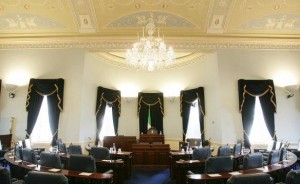 First, some background. Seanad Éireann, as I wrote in a piece for The University Observer in October,
is an imperfect institution. It is little more than a political car park for those postponing the inevitable decline into retirement; a breeding ground for a political party’s new hopes, trying to blood their new meat in the life of Leinster House before the savagery of the Dáil floor; and a consolation prize for those who came close-ish to winning a seat in the lower house in the previous election.
Its work is limited; its relative power to put a stop to legislation is nil; its members largely wish they were elsewhere. It’s a morose place where the good go to die and the young come to roar, all just to get a few minutes’ token coverage on Oireachtas Report three times a week for their trouble.
And, despite the chamber’s activity, this is a perception I think the Seanad has probably not done a whole lot to counter.
However, it does not need to be so, and the members of the House know it. In March 2009 The Late Late Show hosted a discussion (sadly no longer available which featured several members of the upper house arguing the merits of reforming the upper house to becoming an entity that the public had knowledge of, respect for, and trust in.
The Seanad, of course, has had its fair share of enemies in the past. In 1936, as Donie Cassidy saw fit to remind us on Wednesday morning, de Valera – frustrated with a Seanad full of independents and its hampering his legislative agenda – abolished the chamber completely, only to reconstitute it the following year. In the past, former PD leader Michael McDowell has been an outspoken critic of the House and demanded its scrapping – only to turn around a few months ago and say he felt it neither “wise nor beneficial” to scrap it, and to call for its reform last week.
That, of course, leaves Enda Kenny, who seems not to have noticed that should he conspire to lose the next election (an entirely plausible hypothesis) that the manner in which local councillors elect the majority of its members will guarantee an anti-FF majority irrespective of the Taoiseach’s nominees. Except a volte-face soon.
The Seanad and students: natural bedfellows
That volte-face, of course, will have been made all the easier to bare by the Seanad doing its best, as Suzy put it, to earn its keep this week. When I was involved in student politics, way back when, I ran for Chair of UCDSU Council because I loved two things: procedure and its application, and a decent debate. More than anything, though, I used to love the annual trip to USI Congress, and all because of Kissinger’s immortal words:
Student politics are the most vicious kind of politics that exist, because the stakes are so low.
While Kissinger’s edict is often interpreted in a cynical way, I choose to interpret it in a more well-meaning manner. Student politics are so vicious because the practical imnplications of their debates are not of a student’s concern. Thus, a USI debate on whether the morning-after pill should be available over the counter (to name one example that comes to mind) became an intense moral dissection of how such an act would play on society, and the slippery slides it may lead the country to.
The difficulty, of course, with being inside the circle of student politics is that it’s too easy to forget thaat such arguments will not lead to an immediate legislative shift. USI passing a motion calling for the pill to be over-the-counter does not mean that young girls can walk into a chemist the following day. But that real life implication is divorced from the debate: it’s all about the moral, the wrong and the right.
(The USI debate I mention, by the way, ended in a tie. Which, I thought, was a perfectly appropriate and meaningful result.)
I like to think of the Seanad as being in a similar conundrum, though naturally with the stakes raised. But watching Rónán Mullen and the Fianna Fáil dissidents argue the right of a civil servant to decline registering a civil partnership – because a truly liberal society, they argued with a degree of merit, shouldn’t force people to act against their will – rang a lot of the same bells.
The Seanad is, in de Valera’s original vision, that kind of chamber able to apply the Dáil’s hypotheses to the real world and critically analyse their merits in a way which the Dáil itself – handcuffed by the professionalism of the politicians who sit in it – cannot.
Sadly, this role is one that a further ingratiation with the Dáil itself – and, by the same virtue, the political ‘establishment’ – only serves to lose. Where those with commercial expertise should be easily electable to the Industrial Panel of the Seanad, they usually can’t – not, at least, unless they’re a member of a political party with a significant presence on local councils.
But this week’s debate – which debated, in a genuine sense, the merits and demerits of the legislation before it in a way the Dáil could never have managed – showed that the Seanad still has the capability to act in the way The Long Fellow would have wished for. Once the culture of free rein and conscience had been established by one FF senator deciding to jump ship, it made it all the easier for two more to join him. And suddenly, the usual rubber-stamping the Seanad gives to the Dáil’s work became that little bit more hard to come by, and the Seanad thus acted closer to the way it’s actually meant to. And when it works… by God, it works.
Ireland doesn’t work
The major problem with Ireland as a democracy is that the legislative branch simply doesn’t function in the way a legislative branch is supposed to. In other nations, a local MP is elected with only a minor responsibility to serve their constituents and a far greater focus on their legislative agenda. The Oireachtas, in short, isn’t meant to be a forum of local reps, it’s meant to be a body of lawmakers. And sadly, it’s largely anything but. We continually elect the likes of Jackie Healy-Rae to our parliament; people with every interest on making sure their name is emotionally attached to the latest main road linking two towns, and no interest in being the one putting their name to the legislation that actually builds it.
The Seanad, though, is our getaway clause. The Seanad is the area in which our legislators are not bound by culture to hold constituency clinics or to fight for the interests of the people from their locale who share their political hue. The Seanad is our chance to elect legislators who just want to legislate. People like David Norris, Joe O’Toole or Shane Ross. Lawmakers. Not public representatives, just parliamentarians, who want to be in the legislature because they want to legislate.
So let’s make it work
So, with that in mind, here’s a couple of quick ideas to get the Seanad going.
First of all, let’s give the Seanad a far shorter recess than the Dáil – and let the public know about it. Today’s news agenda was entirely sculped by the fact that the Dáil will be in recess for twelve weeks. Nobody seemed to remark for a moment that the Seanad will be sitting again next Tuesday, quietly getting on with things while everyone assumes they’re on holiday.
Further to this, given the fact that the Dáil isn’t sitting until late September, use the extra time wisely and get the Seanad sits to work through its backlog of undiscussed motions. Thursday’s Seanad order paper – listing all the motions and bills on the body’s agenda to be discussed – ran to 16 pages. While the Dáil is on pause, introducing new bills only adds extra work – but there’s a lot of motions, many of them apolitical, sitting on the agenda waiting to be discussed. The Seanad is our prime national debating forum. Let’s let it debate and play to its strengths.
Let’s also remove its image as a halfway house between the creche and the deathbed by holding Seanad elections directly alongside Dáil elections. Most people have contempt for the Seanad because it’s populated by people on their way into, on their way out of, or in between stints in the Dáil. By putting the elections at the same time, the Seanad ballot papers will be populated only by people who want to be on them. A house of parliament shouldn’t be somewhere people see as a silver medal. The Seanad, and Ireland, deserves better than being a consolation prize.
Let’s introduce the graduate reform programme we approved in a referendum 31 years ago this month (!!). Currently Trinity graduates get 3 senators all to themselves; graduates from UCC, NUI Galway, NUI Maynooth and UCC share another three between them. Those who graduated from two Irish universities get no representation, nor do any from the ITs. Let’s pass an act getting the institutions to hand over their graduate records, and task the NUI with maintaining a roll (they already do it for four big colleges, so why not?). Then merge the two three-seaters into one six-seater graduate panel, et voila – instant improvement in public profile.
Of course, all of that comes as a stepping stone before an actual Seanad reform. With people from every side of the House being in favour of making the Seanad more relevant, why not capitalise on that appetite – and the inevitable few months’ downtime between an election and the Seanad convening properly – to formulate universally acceptable ideas on what should change, and have them ready for approval as soon as things get going.
Let’s further divide the Seanad from the Dáil by having it not acknowledge party memberships. By all means, have a Government-sponsored minority (let’s perhaps allow the Taoiseach their discretion to keep their 11 nominees) to allow some coordination of the legislative agenda between the Houses, but having a stable of independents would require every piece of legislation to command a cross-industrial consensus. And if that means that legislation is restricted to the practical things we can all agree on, then that’s no bad thing.
And hopefully, all of the above will help give the Seanad its own identity. If it’s to survive and thrive, it’s going to need the public to believe in it. So plug its work and existence separately to that of the Dáil. That’s going to mean giving it its own significant presence on the imminent MerrionStreet.ie. (Currently the YouTube channel is almost entirely made up of Dáil speeches.)
The future
The Seanad is a house of parliament of one of the countries most envied by the world. It deserves better than being a stepping stone or retirement home. It should be modelled to play to the strengths of those who want to be in it.
Perhaps someday, someday, it might what it deserves. Until it does, we merely get what we deserve for putting up with it being second best.
Seanad reform: Fixed terms?
Chatting to a friend this morning about the general laying of the political land – including that story about the Donegal County Council annual budget* – we ended up on the thorny issue of parliamentary reform and stumbled across the idea that while a fixed-term parliament (à la the United States) might not be a perfect system, the possibility of having one of two houses sit in fixed terms while the other sit to a maximum length was floated briefly.
 In Ireland this would mean that while the Dáil would still sit to its maximum five-year term and be dissolved whenever necessary, while the Seanad would have a fixed term – it was suggested four years, so as to avoid the chance that it might end up running almost perfectly parallel to the Dáil and to stop it becoming as anonymous as the European Parliament (not of course that the Seanad is more relevant than EuroParl currently is).
It struck me as being a pretty good idea – instead of having the American system where either house could be swung by a single election, when polling for either house came around we’d have a fair bit of jostling to win public support. While the Seanad’s current inability to stop most Bills from passing outright would likely not be moved, surely we’d be a step farther away from the us-versus-you attitude that destroys so many parliaments?
What do you think – as part of a greater Seanad reform, wouldn’t a fixed term independent of all other bodies (the Dáil, local councils, the European Parliament) be a good idea?
* As an aside, if FF are part of an alliance in Donegal County Council that can elect a Mayor, why did they need to rush through a Budget vote when presumably their alliance was going to win it?
The Upper House rules
A piece I wrote for today’s University Observer on Seanad reform and why getting rid of the Seanad, as per Enda Kenny’s proposal, is a myopic and short-term solution to a longer-term problem…
~~~
Let’s be clear from the off: Seanad Éireann is an imperfect institution. It is little more than a political car park for those postponing the inevitable decline into retirement; a breeding ground for a political party’s new hopes, trying to blood their new meat in the life of Leinster House before the savagery of the Dáil floor; and a consolation prize for those who came close-ish to winning a seat in the lower house in the previous election.
Its work is limited; its relative power to put a stop to legislation is nil; its members largely wish they were elsewhere. It’s a morose place where the good go to die and the young come to roar, all just to get a few minutes’ token coverage on Oireachtas Report three times a week for their trouble.
 With the Seanad being the almost entirely useless entity it has become, it was prudent for Enda Kenny to take a stab (almost literally) last week by proposing its abolition, saving the taxpayer about €25m per year, as part of an Oireachtas reform package that would also see the number of TDs cut by about 20 per cent. The country has grown frustrated with a body that it sees as nepotistic and ineffective, and Kenny needed to be seen as proactive in tackling what is, legitimately, a high-profile waste of exchequer money.
The abolition of a house of parliament is a big choice to make, and one that here, at least, would require a referendum of undoubted painstakingness equal to a Lisbon. Process aside, it’s also a fundamental amendment to the operation of a parliamentary democracy. What Enda Kenny seems to have overlooked, however, is that the Seanad can easily be reformed into a body that works, without necessarily triggering any political seachanges.
The Seanad, in its current form, was established by de Valera’s new Constitution in 1937, with its makeup inspired by Catholic social teaching of the times, led by Pope Pius XI and his visions of social order being based on the co-operation of vocational groups (a system that can be likened to the modern notion of social partnership). With this in mind, the Constitution established five Vocational Panels, with the prevailing logic being that nominees would have special experience or knowledge of one of the five topics, thus becoming eligible for election to that panel. So, for example, those with knowledge or experience in the business world would be elected to the Industrial and Commercial Panel.
The overall aim was that while the directly elected Dáil would remain – as all lower houses are – a political playground, the Seanad would be able to meditate on the nitty-gritty of applying the Dáil’s legislation in the real world, and transcend the relatively lowly bickering of a party political system.
In the seventy-odd intervening years, though, the Seanad hasn’t worked out quite as planned. Because the members of the five Vocational Panels are elected by members of the country’s town and county councils, the elections have become purely party political, with councillors from a political party voting along their own party lines so that the Seanad ultimately mirrors the political constitution of Ireland’s local government.
Another provision allowing for six members to be elected by graduates of Ireland’s two universities (at the time), the University of Dublin – comprised solely of Trinity College – and the National University of Ireland, including UCD, has fallen flat over the course of history. Ireland has seen newer universities formed in the meantime, and despite a referendum allowing the law to be amended to the contrary, the graduates of these colleges have not yet been offered a vote – creating the valid perception that the authority of the Seanad, like its membership, is limited to a minority of society.
While abolition of the Seanad would solve both of these problems, realistically Enda Kenny’s better legacy would be to reform the Seanad in a meaningful way that allows it to best fulfil the intent of the Constitution. An easy start would be to propose the legislation the Constitution already allows for: a law allowing the graduates of other third-level institutions to vote in the university constituencies.
It’s not as if the Seanad hasn’t come up with enough ideas on how to make itself more useful: no fewer than twelve reports on reform have been published over its lifetime. Indeed, only five years ago one of its own subcommittees recommended the abolition of the Panels, opening up nearly half of the seats to direct public elections, and that the eleven seats filled by the Taoiseach’s own appointees be more reflective of the Republic’s role in Northern Ireland, rather than – as present – being merely used to pad out the Government’s majority in the upper house.
The public, however, shouldn’t be surprised if Enda Kenny changes his tune should he somehow manage to lose the next election; he’ll find that due to his party’s victory in the local elections last June, his party will be in the majority in the Seanad irrespective of the nominees of an opposing Taoiseach. In that light, don’t expect the referendum to come any time soon.
But where does it start?
Yeah, I know, I’m actually blogging! Well, now that I can no longer describe myself as a student (a habit I’m going to find it quite difficult to get out of, I fear) and have to label myself as a “Sports Press Officer” – I’ll explain some other time – I’m going to probably have a little bit more time on my hands. I really can’t believe my five years of UCDness are over, but that’s for another day. Also contributing to my general time-having is the fact that we’ve moved house and now live on Upper Leeson St meaning that travelling is a much less cumbersome exercise, particularly when you can walk to most places.
On that theme, last Wednesday new housemate Mulley organised a bloggers’ tour of Leinster House with the Green Party. It had been ten years since I was inside that place (being classmates with ministerial offspring gets you fairly cool CSPE tours, folks) but since my political enlightenment of sorts, it was the first time to really take in the nature of the place. Ciaran Cuffe, our host, was an utter gent, extending the tour to the party’s offices inside Leinster House and to the Dáil Bar where he was more than happy to have proper chats with anyone who wanted them. Thus, myself and Brennan got a few minutes to have a reasonably in-depth chat with him about life as a TD, the challenges of representing an area with disparate social circumstances, and generally about the function – and more pressingly, the functionability – of the legislature itself.
Here I’ll pause for a quick politics lesson for those who might not be so interested. In the classical breakdown of Government, there are three branches of power: the executive (the panel of Ministers/Secretaries – in Irish terms, the Cabinet), who are charged with overseeing operations and issuing orders; the judicial (the courts system) who rule on the validity of laws and punish those who breach them; and finally the legislature (the Oireachtas), whose job it is to actually make those laws.
Last week on The Late Late Show, Pat Kenny decided to warm up for his new Questions-and-Answers-replacing political debate show by hosting a discussion on parliamentary reform (you can watch it here – skip to 1:16.45). Fintan O’Toole argued for the wholescale reconstruction of most of the bodies, and while people can always choose which parts to agree with and which to ignore, the one part that resonated with me was O’Toole’s assertion that in Ireland, we simply don’t have a functioning government as it’s described in the three-branches approach. The judiciary and executive both work – obviously their merit or competence is a matter of personal opinion) – but the legislative branch simply fails to function. In Ireland, the executive introduce a Bill, it is never debated with any substantive result, and the Government will always get what it wants and have the Bill passed. There is no debate; there is no constructive process leading to a concrete suggestion. The legislature don’t even, as a rule, introduce legislation: the executive comes up with something and the legislature rubberstamp it.
So what do you do about this? After the Late Late debate there is clearly a level of public appetite to examine the alternatives to the PR system or our multi-seat constituencies. So when I had the chance, I asked Ciaran how he felt it would start. Does it, I propositioned, start with his Green colleague, John Gormey, using his capacity as Minister for Local Government declaring he wants a reform and merely introducing a Bill? I remembered his predecessor Noel Dempsey doing something similar before the turn of the millennium and getting nowhere. What needs to happen before a Minister can make such moves and that they actually get somewhere? Why can every Fianna Fáil TD on the Late Late say they agree that reform is needed, but not be in a position to implement it?
The problem is that there is no set path. Are our politicians too scared to be the ones seen to destroy our nice cosy overrepresented system? Are TDs too lazy to introduce single-seat constituencies where they don’t have the option to pawn off any work to other reps for the same people? Ciaran, interested as he was, wasn’t really sure of a solution. If you do, I’d love to hear it.
—
The Dáil trip is described in more detail by Mulley, Darragh and Mark. Oh, and because she asked for a shoutout, hello Steph. 😛
Meanwhile, Scally has started his photobloggery over at cdscally.com. Check it.