Archive for the ‘Technology’ Category
Dear Tim
Thank you for conceiving of the means through which I’m writing to you this morning.
Thank you for envisaging a system which did not penalise me for allowing a blog to languish without updates for two years, and with only three updates since late 2010.
Thank you for choosing a career in science (there’s not nearly enough of that) and for having the pluck to take a job overseas. Not everyone would have the nerve or bravery to do either.
Thank you for your ingenuity in envisaging a series of interlinked pages of data, separated from each other only by a single click.
Thank you for not being too fussy about the fact that people described your conception as the ‘web’ and not as the ‘mesh’ by which you christened it – and for not trying to shoehorn the ‘mmm’ acronym in anywhere.
Thank you for standing back and allowing your principle to replicate, proliferate and spread, and to be used in scenarios far beyond that which you originally envisaged, without putting money in the way.
Thank you for creating a medium which provided me with a professional platform, and ultimately my first real job.
Thank you for creating the hub of a wheel, the spokes of which are leading an unparalleled wave of scientific breakthrough and innovation.
Thank you for empowering the Malala Yousafzais and Julian Assanges (and yes, even the Belle du Jours) of this world to educate, entertain and infuriate us.
Thank you for helping to make this big old frightening world infinitely easier to comprehend.
Thank you for allowing us to create new friendships and to maintain existing ones, even when seas and international borders get in the way.
Thank you.
PS: If you’re annoyed about how little money you’ve made from your creation, check your email – a deposed Nigerian prince is trying to get in touch.
PPS: Editing this post, eight years later, to include user ID verification for Mastodon.
How to create an iPhone ringtone from any mp3
Guess who’s back, back again? Now that I’m a working man (more of which, I promise, will come in due course), writing for a living, it’s about bloody time I pulled up the bootstraps on this here blog and blew the dust off it a little bit.
So, musings and opinions to come in full flow in the days and weeks to come (not least helped because I’ll have a new laptop by then) but in the meantime, a practical one that seems a little bit uncovered by the world at large: how to make an iPhone ringtone from an mp3 file.
This how-to was prompted by Red Mum’s tweet earlier seeking guidance on it, frustrated that there’s an overwhelming amount of paid-for software out there that professes to do a job that any iPhone owner can already do for nothing – without having to download a ringtone from the iTunes store.
(I should add for the benefit of anyone with an AAC file – identified by the file extension .m4a – is already most of the way there, and you can skip down to Step 7.)
So – here goes nothing.
1. Open iTunes and find the file that you’re looking to convert. As a presumptive iPhone user, I can be fairly confident that you already have iTunes installed. If you’re one of the new that doesn’t, then I’m afraid the usual tactic of manipulating free software like Audacity doesn’t work (or, at least, not to my knowledge anyway) because it can’t export the file type you’ll need. You’re also going to need iTunes to put the ringtone on your phone in the first place, so you’re a little flummoxed here.
If the file you’re looking to convert isn’t in the iTunes library, simply play it in iTunes or drag it into the iTunes window and it’ll add.
2. Hit Control (or the Apple key) and comma to open the Preferences window. You’ll need to get in here to change the type of file that iTunes burns by default – more on this in a moment.
3. On the ‘General’ tab, after the ‘When You Insert a CD’ option, hit the ‘Import Settings’ button. This is the option where you tell iTunes what kind of audio files you want it to create when you rip a CD into your music library – you can, if you want, rip the tracks into a size-guzzling .wav file or into a more bog-standard .mp3 file.
This feature has more than one function, though, because you can also use it to convert files that are already in your library to other formats. So, if you wanted to make a .wav file out of an mp3 you already have (or, more probably, the other way around), you can use this iTunes feature to do it.
4. In the window that pops up, on the ‘Import Using:’ drop-down menu, choose ‘AAC Encoder’. This is the format that you’ll need to turn your file into before iTunes will recognise it as a ringtone.
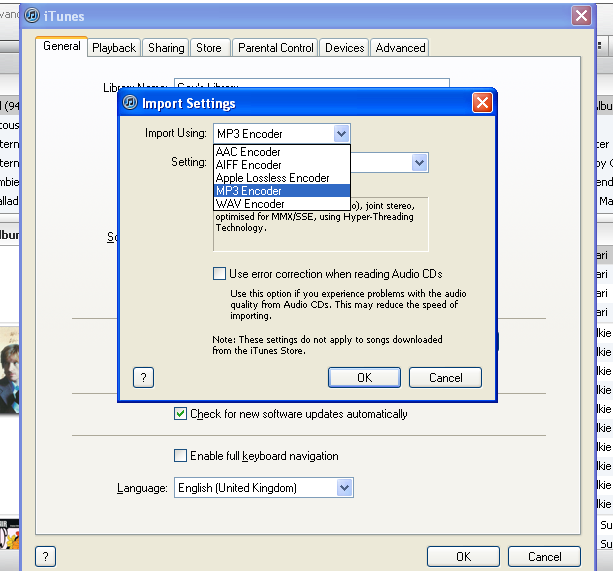
As long as you choose AAC, you can leave the other settings as you like them. Click OK and exit from all the pop-ups until you’re back looking at the file you want to convert.
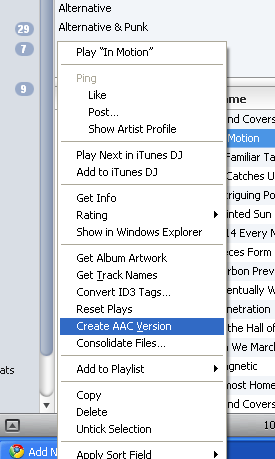 5. Right-click the file you want to use as a ringtone, and choose ‘Create AAC version’ (pictured right). The file will begin to convert into an AAC file. When it is done, you’ll hear a three-note jingle that you might recognise as the default SMS tone on the iPhone.
6. The converted version of your file will now appear in your library just below the original file. See it? It should look almost identical to the previous one. Now right-click the file and click ‘Show in Windows Explorer’ (or, ‘Show in Finder’ if you’re on a Mac). A window will pop up showing where the file is on your hard drive.
7. Rename the file extension from .m4a to .m4r. This is pretty much the only fundamental change you’ll be making to the file. In a Mac, the file extension should appear at the end of the filename by default. In Windows, if you just see the name of the song and not a file extension, then follow these instructions to display the extension.
(If you’re a little like me and can’t stand having an iTunes library with dead links in it, at this point you should go back into iTunes and delete the duplicate file from your music library because the file – songname.m4a – technically doesn’t exist any more.)
8. Double-click on the newly-renamed file and it will open in iTunes as a ringtone. Voila! Now that it’s in your iTunes library as a ringtone, you can drag it onto your iPhone or tell iTunes to sync it when you next plug your phone in.
As a housekeeping measure, you might want to go back into Preferences (again, Control and comma) and change the import default back into an MP3, which makes your files more universally usable. Of course, if you weren’t ripping MP3 files to begin with, then there’s no such problem.
Hope you find this useful. 🙂
Here’s how (if you wanted to) you could manufacture new followers using #Twitterattack
Ah, onMouseOver – you’re so simple.
The string being sent around Twitter today merely inserts a string of JavaScript into the user box and submits it without a user having to click ‘Send’.
So, why not include ‘follow USERNAME’ in the text?
http://t.co/@"onmouseover="document.getElementById('status').value='follow gavreilly';$('.status-update-form').submit();/
On art
In the last week I’ve happened to find myself in two different museums – the Irish Museum of Modern Art in Kilmainham, Dublin, and the rather excellent Ulster Museum at the Botanic Gardens in Belfast (the latter comes particularly recommended – it’s basically a Best Of museum with brilliant stuff across all disciplines).
Two thoughts struck me as I wandered around both:
 – Isn’t there something sad about the fact that, although having a famous artist’s collections distributed around the world means more people have greater access to them, you can’t go to any one place to see an entire artist’s collection? I was meant to be in Amsterdam earlier this week (cheers, Eyjafjallajokull). It would make sense that I would be able to take in the entire collection of Piet Mondrian – an artist whose works have always been particularly striking to me – while in his hometown, or at least his home country. Yet, I saw some of his stuff in MoMA, New York, and more of it in IMMA last week.
Isn’t it sad that there aren’t individual go-to places for this kind of stuff? To me it’s a shame that there’s nowhere where you can see every non-privately owned Warhol / da Vinci / Monet/ Mondrian / whoever.
– Being a geek, and as something of a corollary to the first thought, it strucke me as a shame that that whatever about the merits of having all an artist’s work in one place (because, fair enough, people are allowed to have private collections in one place or another) – why isn’t more of an effort made to harness the internet in allowing people enjoy art from a distance? Why should I have to go to IMMA or the Ulster Museum or MoMA to enjoy a piece of art on tour? Why can’t the Roy Lichtenstein Foundation reproduce graphics of every piece of work the guy painted?
And, more pressingly, why don’t more people create more art for the internet? It seems to me that nobody creates artistic exhibitions made directly for the screen (other than in video form, but I mean in the more traditional sense of exhibition – static artwork and words, etc).
Here’s an idea: make an exhibition that instead of being limited to one place at any one time, exists everywhere for everyone to see. Set up a website, ask people to hit F11 and click the ‘Enter’ link, and use the screen to create and showcase art.
It’s something I’ve been pondering, and something I might revisit. Watch this space.
(And yes, I haven’t blogged in ages. Suffice it to say I’ve been sleeping up.)
Google, China, and the new Cold War
Well, this certainly changes the rules a wee bit.
Last night (or yesterday afternoon in Mountain View time) Google posted a message on its official blog releaving that it had uncovered, in their words,
a highly sophisticated and targeted attack on our corporate infrastructure originating from China that resulted in the theft of intellectual property from Google
…that had also targeted “at least twenty” other major multinationals across a variety of sectors. Google is now undertaking to “review the feasibility” of its Chinese operations, including the ongoing state-ordered censorship of search results, and says it may cease its Chinese site, Google.cn, entirely if it is unable to reach an agreement with the government.
 In 2006 when Google launched its Chinese site and agreed to remove search results that fell foul of The Great Firewall of China, I wrote an opinion piece for The University Observer on how I felt Google had, in essence, sold out by agreeing to curb the free flow of information and foregoing the concept of net neutrality by allowing its results be manipulated by outside agents (in this case the Chinese authorities). When I became an intern at Google that summer, and the intake were offered an audience with the senior legal heads at the European HQ, it seemed to be the only topic any of us wanted to discuss. While at the time Google said it reserved the right to review its operations should circumstances dictate, nobody suspected that they actually would.
Four years on, and here we are – watching the world’s biggest and most well-known internet company threatening to withdraw from what has become the world’s biggest internet population, and perhaps forever closing the book on its mission to organise the world’s information and make it universally accessible and useful.
Reading between the lines on Google’s extraordinary blog post, it’s difficult to see how the tapping scheme being referred to could originate from anywhere other than the Chinese government themselves. If this scam was being perpetuated by some kind of vigilante mob, or a pro-suppressive pseudo-terrorist group, then Google wouldn’t be massively concerned about ethics: they’d merely be informing the FBI and local authorities worldwide (one must assume, in fairness, that China would do little to help).
But Google aren’t doing that. They’re going straight to the government to complain – meaning that the offending party is probably the government itself.
I have no doubt that China aren’t the only country operating a global email tapping scheme; I’d wager that almost all tech-literate nations keep some kind of covert eye on what les indesirables might be getting up to, quite possibly including Ireland. China is no doubt alone in its actions. But when you’re China, you’re going to be watched; and if you’re going to pick a fight with the world’s biggest internet company, eventually they’re going to notice and track you down.
For the world’s biggest internet company to abandon the world’s biggest internet market would be unthinkable, but this is the overwhelmingly probable outcome of what lies ahead. Google says it has decided that
we are no longer willing to continue censoring our results on Google.cn, and so over the next few weeks we will be discussing with the Chinese government the basis on which we could operate an unfiltered search engine within the law, if at all. We recognize that this may well mean having to shut down Google.cn, and potentially our offices in China.
To put it simply, a Chinese government that has gone out of its way to suppress any active and apparent opposition, and to expunge events like the Tiananmen Square protests from history (oddly, there lies a plaque in the centre of Tiananmen commemorating the fact that in 1989, ‘nothing happened’) is not going to allow itself be pressured by an outside agency to immediately change tack. An uncensored Google.cn would allow Chinese surfers view material relating to all manner of events that China would rather have its people not know about.
I used to work with a Chinese woman and had to sit her down one day to watch the iconic video of the 1989 protests, including the scene where the lone man stood in front of the tanks on the abandoned streets. She had never seen it before; she had only heard the slightest rumour, and only since she had moved to Ireland, that there was some kind of minor kerfuffle in the capital city. China is well-schooled in the art of suppressing information; Google kicking up a fuss is not going to make it change tack. And so, Google will pull out of China.
And therein lies the kicker. If the scam Google have uncovered is far-reaching enough to merit informing almost two dozen other major multinational corporations, and has Hillary Clinton calling on Beijing to explain itself (following her President’s lead in declaring internet security a “national security priority”), it’s highly probable that Google won’t be the only major company closing its Chinese doors. A mass withdrawal of U.S. corporations from China will inevitably mean the discussion of trade sanctions against China, on a scale dwarfing the nature of America’s issues with Cuba, and – quite possibly, and I don’t believe I’m over-reacting in suggesting this – a new economic Cold War.
Time will tell.